
There’s a word I need you to know.
Pyometra.
Because I promise you, if you don’t learn it now, you’re going to learn it the worst possible way.. In an emergency room, in the middle of the night, with a doctor telling you your dog is dying.
Here is how it plays out. A female dog comes in..lethargic, vomiting, sometimes already crashing. Her uterus is filled with infection, toxins spilling into her body.This is not a “wait and see” situation or give some antibiotics and go home. This is emergency surgery or death.
And here’s the part that makes this unbearable..It was preventable. Every single time. What would have been a $300 spay becomes a $6,500 emergency surgery, if you’re lucky enough to even have that option. Because sometimes they don’t make it to surgery. Sometimes the infection has already taken too much. And sometimes… the decision becomes financial.
That’s the part no one wants to say out loud: Economic euthanasia.
A completely treatable condition of a preventable condition, ending in death because the cost of saving them came too late and for too much $$$$.
Before you get defensive..Just wait a minute. This is not about judgment. We know how life works. Money gets tight, appointments get pushed. “It can wait.”…Until it can’t.
Pyometra doesn’t care if you meant well, or if you love your dog. It doesn’t care that you were planning to do it next month. It just happens.
Spaying your dog doesn’t just prevent pregnancy. It eliminates the risk of pyometra COMPLETELY.
It also drastically reduces the risk of mammary cancer. This isn’t a regular thing on your to-do- list. Its one of the most important medical decisions you will ever make for your girl.
And here’s the part where I remove every remaining excuse: Access is not the barrier it used to be. We’ve built it into this community.
Hearts Alive Village has two clinics:
HAV Decatur Clinic
3250 N Decatur Blvd
HAV Nellis Clinic
2255 S Nellis Blvd
There are people inside those buildings every day who will take care of your animal like they are their own. I am telling you this because we see emergency pyometra surgeries EVERYDAY. Too many people saying, “I didn’t know.”
Now you do.
If you have an unspayed female dog or cat..schedule it. (Yes, although not as common, it can happen to felines)
If you know someone who’s been putting it off…send this to them. If this makes you uncomfortable…good. That means it’s real.
They are counting on you to make decisions they don’t understand. Don’t let one of those decisions be the reason they don’t survive.
They are counting on us to make the decisions that protect them. That’s the responsibility we signed up for the moment we brought them home.
Let’s honor that.
Looking to adopt a cat in Las Vegas? Want to actually meet and interact with cats before committing to adoption? Welcome to Hearts Alive Village’s Cat Café, where cat adoption meets community, comfort, and a very real vibe check.
Adopting a cat can come with questions. Where did this cat come from? How do they get along with other cats? Are they social, shy, or allergic to your existence?
And let’s be honest, what if the cat takes one look at you and decides you are simply not their person?
At Hearts Alive Village’s Las Vegas Cat Café, you do not have to guess. Our café offers a relaxed, home-like environment where adoptable cats roam freely, interact with each other, and meet potential adopters naturally, just like they would at home.
Why Our Las Vegas Cat Café Is Different
This is not a traditional shelter visit; it is a risk-free cat adoption experience designed to help both humans and cats make the right match.
What we offer:
You get real insight into a cat’s personality, how they play, how they relax, and how they interact with people and other cats before bringing them home.
A Smarter Way to Adopt a Cat in Las Vegas
Too often, cat adoption happens fast, emotional, and without context. At the Hearts Alive Village Cat Café, we slow it down. You get time, clarity, and chemistry.
Because adoption should not feel like a blind date; you should know before you commit.
And honestly, cats deserve that respect too.
Visit Hearts Alive Village’s Cat Café Today
If you are searching for:
You will find it all at Hearts Alive Village Cat Café.
Hearts Alive Village Cat Café: Because cats choose you just as much as you choose them, and the right match changes everything.
Think about it. A microchip the size of a grain of rice can mean the difference between being reunited with a lost pet…or not.
“Well,” you may say, “my pet has a collar and name tag.” That’s a lovely fashion statement, but a collar can easily break or fall off. Then if your dog wanders off or your cat scampers up a tree a few blocks from home, a stranger may find them with no ID. But if the pet has a registered microchip, you have definitive proof of ownership. This is particularly helpful in the case of stolen pets.
Once implanted between the animal’s shoulder blades, the microchip is there to stay. All you need to do is have it checked once a year to make sure it’s working properly and that the registration is up to date.
If that happens to you, a chip greatly increases the likelihood that your pet will be returned to you safely. Recent studies have shown that cats with microchips are 20 times more likely to be returned to their owner. And chipped dogs are returned 2.5 times more than unchipped dogs.
That’s a pretty significant difference. And with millions of pets going missing, you want to do everything you can to ensure that yours finds its way back to you.
A story reported in the PetHealth Network newsletter from IDDEX tells about Spice, the 6-month-old grey and white cat discovered 2,300 miles away from her home. Thanks to her microchip, the shelter in Westbrook, Maine was able to identify her guardian in Albuquerque, New Mexico and return Spice to her loving home.
Some manufacturers are enhancing the chips’ capabilities and adding functionality by programming the chip to open your pet door only when your pet approaches. This helps keep out stray critters that may wander into your home. Some chip makers also offer lost pet alerting services and even travel assistance for folks who like to vacation with their pets.
At Hearts Alive Village, every pet we adopt out is microchipped before it goes out the door. If you have a pet who is not yet chipped, our Vet Clinic offers the service for only $25. It’s a simple, painless procedure. Call for an appointment, and put your mind at ease.
Here are more tips on chips:
If you notice your four-legged friend looking glassy-eyed, having difficulty walking or dribbling urine, chances are they’ve gotten into some cannabis edibles. This is not a good thing! THC can be dangerous to the animal’s health.
Other symptoms to watch for include nervousness, tremors or seizures, difficulty regulating body temperature and slow heart rate.
Now that recreational use of marijuana has been legalized in more areas, the rate of toxicosis in animals is increasing. Our curious pets are ingesting unattended edibles. But not to worry, if the edible doesn’t contain THC, your pet will probably be fine.
THC isn’t the only dangerous ingredient lurking in some edibles. Treats that contain chocolate, raisins, xylitol or high fat substances that are known to be fatal can also cause serious problems in pets.
The effects of THC may vary from one animal to another depending on:
Be sure to keep your marijuana, including edibles, away from prying paws and nosy noses.
Supportive care may be needed to regulate the animal’s temperature. Fluids and anti-vomiting meds should be given to prevent dehydration.
Activated charcoal will help bind the toxin in the stomach. As a last resort, the animal’s stomach may have to be pumped to remove the marijuana from its system.
888-426-4435
Or rush your pet to
Veterinary Emergency and Critical Care
8650 W. Tropicana Avenue, #104
702-262-7070
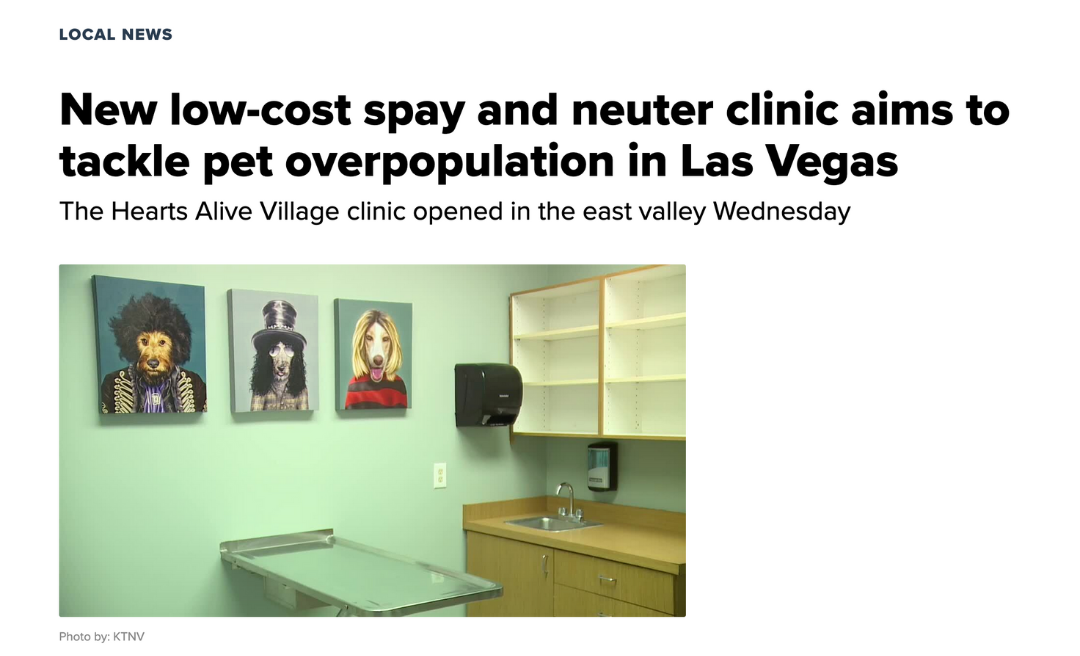
The Hearts Alive Village opened its new low-cost Spay/Neuter Wellness Clinic on Nellis Boulevard Wednesday morning.Anyssa Bohanan got an early preview inside the new clinic and heard why their services are needed in the valley. The facility houses the Veterinary Forensics Program, which has already investigated more than 200 cases of animal cruelty and neglect.
Read more here: https://www.ktnv.com/news/new-low-cost-spay-and-neuter-clinic-aims-to-tackle-pet-overpopulation-in-las-vegas
Think of spay and neuter as birth control for your pet! Both are simple surgical procedures in which the animal’s reproductive organs are removed. A spay is done for females; neuter is for males.
We recommend you spay/neuter your pet between 4-6 months of age.
Why spay your female dogs and cats:
Why neuter your male dogs and cats:
And the most important reason to spay or neuter your pet (drum roll, please!): you’re helping put an end to pet overpopulation in the community!
If your pet is not yet spayed or neutered, please make an appointment now at the Hearts Alive Vet Clinic. We offer low cost spay/neuter services. Simply email frontdesk@heartsalivevillage.org to book your procedure.


